The Greener Revolution
Across our counties, farmers are joining forces to restore nature at a scale none could achieve alone. BBOWT and Future Nature – our wholly-owned ecological consultancy – are proud to support this quiet revolution, as Scott Brown, Land and Farm Advice Service Manager at Future Nature explains.

Picture neighbouring farmers gathered in a draughty barn, poring over habitat maps on a laptop while an ecologist explains where curlews nested last spring. Later, they will walk the host’s farm together, swapping notes on what’s working (and what isn’t). This is a farmer cluster in action: practical, collaborative, and farmer-led.
What is a farmer cluster?
A farmer cluster is a group of neighbouring farmers and landowners who choose to work together on shared environmental goals. The concept emerged in 2012 when the Game & Wildlife Conservation Trust brought together farmers on the Marlborough Downs. By thinking at landscape scale rather than field by field, they achieved far more for wildlife than any could manage alone.
Today there are more than 220 clusters across England, covering more than 450,000 hectares – nearly four times the area of all National Nature Reserves. Here in Berkshire, Buckinghamshire and Oxfordshire, we have a thriving network involving over 450 farms, ranging from small neighbourhood groups to some of the country’s largest and most ambitious.
What makes clusters special is that they are farmer-led and self-determining. Farmers choose their own priorities and decide how to work together. A skilled facilitator helps coordinate activities and navigate funding, but farmers remain firmly in charge.
While nature recovery is often the starting point, benefits extend much further: sharing knowledge, trialling new approaches, joint purchasing, collaborative business ventures. In an industry where isolation is common, clusters offer community, peer support, and the knowledge you’re not facing difficult times alone.
Our role
BBOWT and Future Nature are both deeply involved in supporting farmer clusters across our three counties, but as enablers, not directors. BBOWT facilitates the Upper Thames Farmers’ Cluster directly, while Future Nature advisors support the South Chilterns Cluster, Wessex Downlands Cluster, and the Regenerative Agriculture Accelerator Programme in the Cotswolds. Because BBOWT and Future Nature both have skilled and experienced farm advisors, we jointly manage this work as part of our charitable mission, not a commercial service.
Through our Farmer Facilitator Networks project, funded by the Rothschild Foundation, we also support facilitators right across the region by helping them share knowledge, develop skills, and collaborate.
We are members and partners in other clusters too. The Ray Cluster forms the backbone of our landscape scale Reconnecting Bernwood, Otmoor and the Ray project, and our Foxholes nature reserve sits within the North East Cotswold Farmer Cluster – one of England’s largest, with over 150 farms spanning 42,000 hectares. This remarkable group has measured soil health on 36 farms, secured a Landscape Recovery pilot for the River Evenlode, and is developing new funding options that help farmers care for the natural assets on their land while maintaining control of the benefits.
The farmer's view
The organised farm visits are especially fascinating and offer a valuable opportunity to share ideas. One recent visit provided some immediate pointers, while follow-up advice from BBOWT on trees and water voles has already been helpful. I'm so glad to have joined the Upper Thames Farmer Cluster.
Opportunity knocks
With 70% of England’s land used for farming, the choices farmers make are critical to meeting national targets, from Local Nature Recovery Strategies now being developed across every county, to the commitment to protect 30% of land for nature by 2030. Farmer clusters offer a way to turn these ambitions into action from the ground up.
British farming is navigating enormous change: old subsidies phasing out, new environmental schemes, and volatile markets. In January, Environment Secretary Emma Reynolds announced a £30 million Farmer Collaboration Fund to support farmer groups and extended Farming in Protected Landscapes funding for three more years. The government’s Farming Profitability Review concluded that farmer-led clusters have ‘proven landscape recovery can be scaled across England’.
This recognition is welcome, but the work remains vulnerable. Facilitators typically rely on short-term grants of 12-24 months, but building trust takes time. Support now can make a huge difference.
Crucially, clusters don’t just deliver projects, they change how farmers think about their landscape. When neighbours learn to work together across boundaries, that culture of collaboration persists long after any funding stream ends.
Farmer clusters show what becomes possible when neighbours work together across boundaries – mending the gaps in our fragmented landscape. It is conservation powered by the people who know the land best.
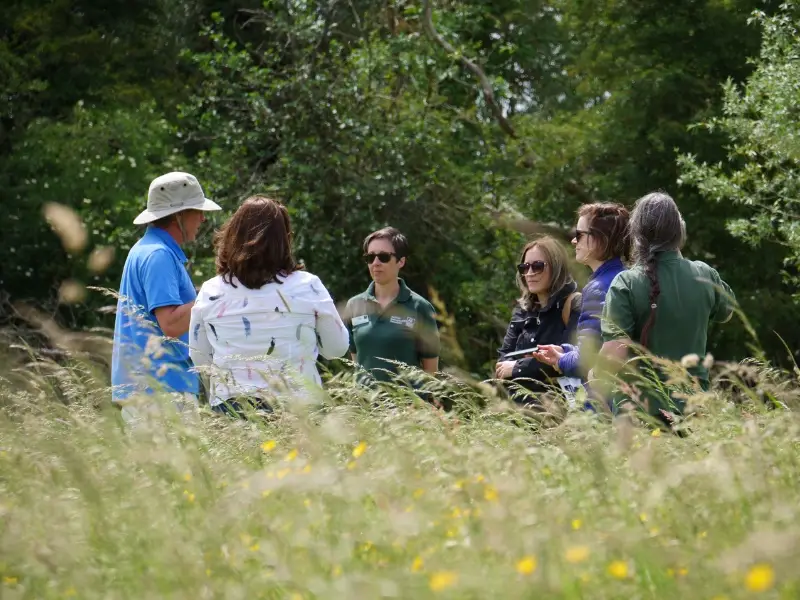
Image credits: Red kite over farmland: Jon Hawkins/Surrey Hills Photography; People on farmland tour: Becky Chesshyre; Barn owl: Chris Gomersall/2020VISION